Blog > Why Quincy, IL Must Get Uncomfortable About Housing
Quincy has hovered around 40,000 people since 1940 — and we still don't have enough homes.
Watch the full video on YouTube · Open The Future of Housing playlist
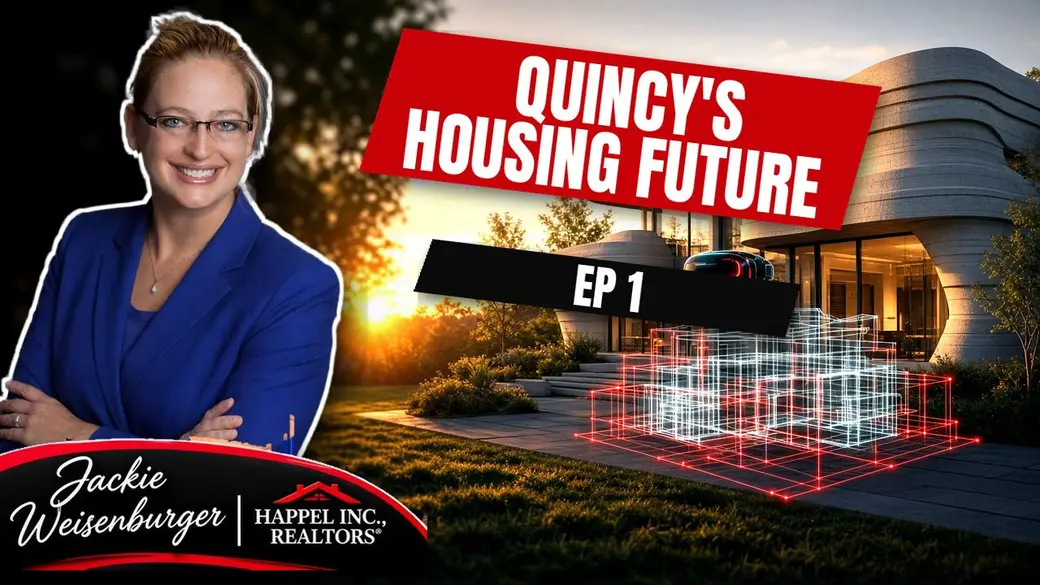
I'm Jackie Weisenburger, a full-time real estate broker with Happel Inc., REALTORS in Quincy, Illinois. This post is the companion to Episode 1 of The Future of Housing, a 10-video series about the tools, the policy, and the mindset it will take for our town to add the homes we need. The theme is simple: we have to get uncomfortable to get comfortable.
The 40,000-person paradox
Here's the paradox. While Quincy stayed near 40,000 people, the city limits grew from 6.4 square miles to 16. The map got bigger. The housing supply did not keep up.
That finding comes from the 2023 Comprehensive Housing Needs Assessment by the Great River Economic Development Foundation (GREDF), approved by the Adams County Board and the Quincy City Council in September 2023. A larger footprint does not automatically create homes people can buy, rent, or move into.
This is not only a Quincy problem
In November 2024, Freddie Mac estimated the United States was still short 3.7 million housing units as of the third quarter of 2024 — only a slight improvement from 3.8 million in late 2020. Despite adding 5.8 million units over those years, demand rose almost as fast.
So no, this is not only a coastal story. Small Midwest markets are in it too.
The GREDF numbers for Quincy and Adams County
Now the local numbers, because this is where it gets real.
In that 2023 GREDF study, market-rate rental vacancy in Adams County and Quincy was 0.7 percent. That is not a balanced market. Affordable-rate vacancy was 3.0 percent — still tight.
GREDF called for new housing across several types, focused in part on three- and four-bedroom houses:
- Single-family homes: 100 as soon as possible, then 150 more by 2028 and 250 more by 2033
- Condos and townhomes: 50 to 75 units right away, then 100 more by 2028 and 100 by 2033
- Market-rate rentals: 75 to 100 now, 100 to 125 by 2028, and 90 to 100 by 2033
- Affordable-rate rentals: 50 to 75 now, then 75 to 100 by 2028 and again by 2033
- Senior housing: 125 units as soon as possible, 100 to 125 more by 2028, and 150 to 200 by 2033
About 20 percent of the community was already over 65, and more than 30 percent will be over 65, or reaching 65, in the next decade. Those are homes for families, workers, renters, downsizers, and neighbors aging in place.
You can feel the shortage
You can feel that shortage if you work here. Employers trying to recruit talent. First-time buyers with almost nothing to choose from. Seniors who want to downsize and don't have an obvious next step.
Illinois Policy reported that for-sale inventory in the Quincy metro fell from 379 homes in December 2019 to 215 in December 2025 — a 43 percent decline. Fewer homes make hiring, moving, and staying near family harder.
This is not a theory series
Quincy already has a Strategic Housing Task Force. In 2026, that group put live recommendations on the table — duplexes, quadplexes, parking rules, and modernizing how we treat factory-built homes — with a possible city council vote by the end of the year. I will walk those later in this series, with sources.
The goal is understanding the choices in front of us, not panicking about them.
What's coming next
The rest of The Future of Housing looks at the tools a tech-savvy local market can actually use:
- Virtual reality home tours, including a Miami condo buyers walked through before it was built
- 3D-printed houses, and what happened when that technology reached the Midwest
- 3D tours and digital twins you can use on a listing this week
- Kit homes, modular construction, missing-middle housing, and zoning
- ADUs, smaller homes, aging in place, and build-to-rent
- AI, smart homes, and what a local broker can actually do with these tools
I will not hype you. Every number in this series has a source. When a cost is a company's claim, I will say so. Innovation without due diligence is just a headline.
Getting uncomfortable means sitting with a new housing type, a new rule, or a new piece of tech long enough to understand it. Getting comfortable is what happens after a town decides, on purpose, to add the next unit.
Let's keep this conversation going
If this is useful, watch Episode 1 and open The Future of Housing playlist so you don't miss Episode 2. Next time: the condo buyers toured in virtual reality before a single floor was poured.
Questions about buying, selling, or what these changes could mean for your property? I'd love to talk it through.
Contact Jackie Weisenburger, full-time real estate broker, Happel Inc., REALTORS® 📞 Call/Text: 217-430-9353 📲 Learn more or get started: https://fulltimequincyagent.com 🔑 Buying? https://fulltimequincyagent.com/buy 💰 Selling? https://fulltimequincyagent.com/sell 📬 Contact Jackie directly: https://fulltimequincyagent.com/contact